


Quick answer: The best subway tile manufacturer and exporter is one that delivers consistent shade and size, offers a wide range of sizes, shapes and finishes, publishes clear packaging details, handles export paperwork, and gives you transparent pricing and lead times. Use the 10-point checklist below to compare suppliers before you place a bulk order.
Subway tiles are no longer just plain white rectangles. Today they appear in kitchen backsplashes, bathroom walls, hotel lobbies, cafés and feature walls in modern homes. Demand keeps growing worldwide, so importers, distributors, builders and designers keep asking the same question: how do I find the best subway tile manufacturer and exporter without risking a bad shipment?
This guide explains what to look for, which questions to ask and which red flags to avoid. It is written for importers, wholesalers, contractors and project buyers sourcing ceramic subway tiles from India.
What Makes a Subway Tile Manufacturer “the Best”?
A good supplier is not the one with the lowest price on a quotation. The best manufacturer is the one whose tiles look the same in box 1 and box 1,000, arrive unbroken and match the sample you approved.
A reliable subway tile manufacturer and exporter usually has four strengths:
- Production control: in-house manufacturing, not just trading.
- Product range: many sizes, shapes, colours, finishes and surface textures.
- Export experience: packing, documentation and container planning.
- Communication: fast replies, clear samples and honest lead times.
If a supplier is missing two or more of these, think twice.
Why India, and Why Morbi?
India is one of the largest ceramic tile producers in the world, and most of that capacity is clustered in Morbi, Gujarat. Morbi is known globally as a ceramic hub where raw material supply, skilled labour and export logistics sit close together. You can read more about the city on Wikipedia’s Morbi page.
For buyers, this cluster means three practical advantages:
- Competitive pricing because of scale and local supply chains.
- Faster turnaround on new designs and custom colours.
- Access to nearby ports such as Mundra and Kandla, which keeps freight planning simple.
That is why many global importers look for a subway tile manufacturer in Morbi when they want both variety and value.
10 Things to Check Before Choosing a Subway Tile Exporter
1. Real Manufacturing Capability
Ask whether the company manufactures in its own unit or only trades. Manufacturers control quality, can customise and give better prices on repeat orders. Request a factory video, photos or a virtual tour.
2. Consistent Shade, Size and Calibre
Subway tiles are installed in tight grid or brick patterns, so even small differences in size or colour show up on the wall. Ask about:
- Shade and batch numbers printed on each box
- Calibre (size tolerance) within the same batch
- Warpage and edge straightness
Always order from a single batch for one project area.
3. Print and Surface Quality
Modern subway tiles can carry stone, concrete and abstract looks, along with carved and 3D surfaces. Ask to see close-up photos and physical samples of the exact finish you plan to buy, not just catalogue images.
4. Size and Shape Range
A strong exporter offers more than the classic 3×6 inch format. Look for long, wide and square formats, and for shapes such as picket and feather, so one supplier can serve different customers. See the size guide below.
5. Finish Options
Your customers will ask for glossy, matt, velvet, rustic and textured looks. A broader range of finishes lets you stock fewer suppliers and win more projects.
6. Quality Standards and Testing
Ask for technical data and test reports. International tile quality is commonly benchmarked against standards such as ISO 13006 (ceramic tile classification) and ANSI A137.1 in North America. You can learn more about North American standards from the Tile Council of North America. Key points to confirm:
- Water absorption group
- Breaking strength
- Surface quality and chemical resistance
- Dimensional tolerance
7. Packaging Transparency
Broken tiles are one of the biggest hidden costs in tile imports. A good exporter publishes box quantities, box weight, pallet type and container loading figures in advance, so you can plan freight and budget accurately. A page like Packaging Details is a strong sign of a professional exporter.
8. Export Experience and Documentation
A true exporter handles the paperwork smoothly. This includes the commercial invoice, packing list, bill of lading, certificate of origin and any country-specific certificates. Indian export rules are published by the Directorate General of Foreign Trade (DGFT).
9. Clear Pricing, MOQ and Lead Time
Ask for a written quotation that states:
- Price per sq. metre or per box
- Incoterms (FOB, CIF, CFR)
- Minimum order quantity
- Production and dispatch time
- Payment terms
Hidden charges are a sign of a weak supplier.
10. Samples, Catalogue and Customisation
The best exporters send samples quickly, keep an updated, downloadable catalogue and can develop custom colours, sizes or finishes for project orders. A searchable catalogue with filters for shape, size and surface also saves you time at the selection stage.
Subway Tile Sizes, Shapes and Finishes
Range is where many buyers compare suppliers first. Based on the filters in the Subway Tiles LLP catalogue, these are the formats, shapes and surfaces available:
| Size (mm) | Look | Best For |
| 75 x 225 | Classic, compact brick proportion | Residential walls, cafés, backsplashes |
| 75 x 300 | Long, slim, modern brick look | Kitchen backsplash, bathroom walls, feature walls |
| 100 x 300 | Wider, bolder long format | Commercial walls, hotel bathrooms |
| 150 x 200 | Broad rectangle | Statement walls, retail and hospitality |
| 200 x 200 | Square | Floors-to-wall patterns, accent areas, grid layouts |
Shapes: Rectangle, Square, Picket, Feather and Trapezoid.
Surface finishes: Glossy, Matt, Matt & Luster, Velvet Matt, Rustic Matt, Carved Glossy, 3D Carved Glossy and 3D Ink Matt.
Colour families: Beige, Black, Blue, Brown, Green, Grey, Orange, Pink, White and Yellow.
Pick two or three core sizes for your stock, then add specialty shapes and finishes for designers and premium projects.
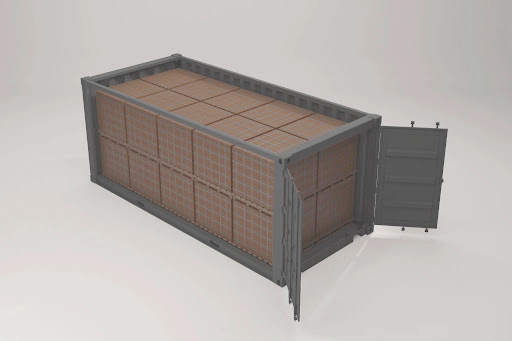
Packaging and Container Loading
Packaging data tells you a lot about an exporter. The Packaging Details page of Subway Tiles LLP lists box quantity, box coverage, box weight, pallet size, boxes per pallet and container loading for each format. Two examples:
| Format | Pcs / Box | Sq. m / Box | Weight / Box | Container Loading |
| 10 x 20 cm | 50 | 1.00 | 13.2 kg | 1,920 sq. m (Euro pine pallet) or 2,000 sq. m (normal jungle wood pallet) |
| 7.5 x 30 cm (8 mm thickness) | 44 | 0.99 | 13.85 kg | 1,871.1 sq. m on 21 pallets |
Two pallet types are offered: Euro-type pine wood and normal jungle wood. Check which one your port, customs and warehouse prefer, because pallet material can matter for import rules in some countries.
Export Documents and Shipping Basics
Before your first order, confirm these basics:
- HS code: ceramic wall tiles typically fall under HS 6907. Confirm the exact code with your customs broker.
- Port of loading: most Morbi exports go via Mundra or Kandla.
- Documents: invoice, packing list, bill of lading, certificate of origin and any pre-shipment inspection report.
- Payment terms: a common structure is an advance with the balance against documents, or by L/C.
- Inspection: consider a third-party inspection before the container is sealed.
Red Flags to Avoid
- Prices far below the market average
- No factory address or no willingness to share photos or videos
- Refusing to provide samples or technical data
- No published packaging or container-loading details
- Vague answers on MOQ, lead time or payment terms
- No export history or references
- Pressure to pay the full amount upfront without documents
Quick Comparison Checklist
Copy this list and score each supplier from 1 to 5:
- Own manufacturing unit
- Shade and size consistency
- Size, shape and finish range
- Surface and print quality
- Test reports and standards
- Packaging and pallet details
- Export documentation
- Pricing transparency
- Sample speed
- Customisation ability
- Communication
The supplier with the highest total score is usually your best long-term partner.
How Subway Tiles LLP Fits This Checklist
Subway Tiles LLP is a Morbi-based manufacturer and exporter of small-format ceramic tiles for homes, hospitality spaces and commercial projects. Here is how the company lines up with the points above:
- Collections: 20 collections in the Collections range, including Miami, Picket, Plaka, Porto, Tokyo, Flute, Feather and Fes Dé.
- Formats: five sizes, five shapes and eight surface finishes, filterable in the catalogue.
- Colours: ten colour families, from soft neutrals to rich shades.
- Packaging: full box, pallet and container data on the Packaging page.
- Company: learn more on the About Us page.
Ready to request samples or export pricing? Contact Subway Tiles LLP or email export.subway@gmail.com.
Frequently Asked Questions
Who is the best subway tile manufacturer and exporter in India?
There is no single answer, because the best supplier depends on your market, budget and design needs. Compare manufacturers on production capability, shade consistency, size and finish range, packaging, export experience and pricing. Morbi in Gujarat is the main hub, so start your search there.
What is the standard subway tile size?
The classic subway tile is 3 x 6 inches (about 75 x 150 mm). Many modern collections use longer formats such as 75 x 225 mm, 75 x 300 mm and 100 x 300 mm for a contemporary look.
Which subway tile sizes does Subway Tiles LLP offer?
The catalogue lists 75 x 225 mm, 75 x 300 mm, 100 x 300 mm, 150 x 200 mm and 200 x 200 mm, in rectangle, square, picket, feather and trapezoid shapes.
How many square metres fit in one container?
It depends on the format and pallet type. For example, the 10 x 20 cm format loads 1,920 to 2,000 sq. m per container, and the 7.5 x 30 cm format loads about 1,871 sq. m. Check the packaging details and confirm the container size with the sales team before booking freight.
How do I check subway tile quality before importing?
Request physical samples, technical data and test reports. Check shade and size consistency across multiple boxes, and consider third-party inspection before shipment.
Are ceramic subway tiles good for bathrooms and kitchens?
Yes. Glazed ceramic subway tiles are widely used on bathroom walls, shower areas and kitchen backsplashes because they are durable and easy to clean. Choose the right finish and installation method for the application.
Can I get custom colours or sizes?
Many manufacturers can develop custom tiles for project orders. Subway Tiles LLP offers custom colours, patterns, sizes and finishes. Share your requirement early so the team can advise on feasibility and quantity.
Conclusion
Choosing the best subway tile manufacturer and exporter comes down to proof, not promises. Check real manufacturing capability, shade and size consistency, range of sizes and finishes, packaging data, documentation and pricing transparency. Ask for samples, compare suppliers with the checklist above and build a long-term relationship with the one that communicates clearly and delivers consistently.
To see what a well-documented range looks like, browse the Collections, download the catalogue or send an enquiry for samples and export pricing.